
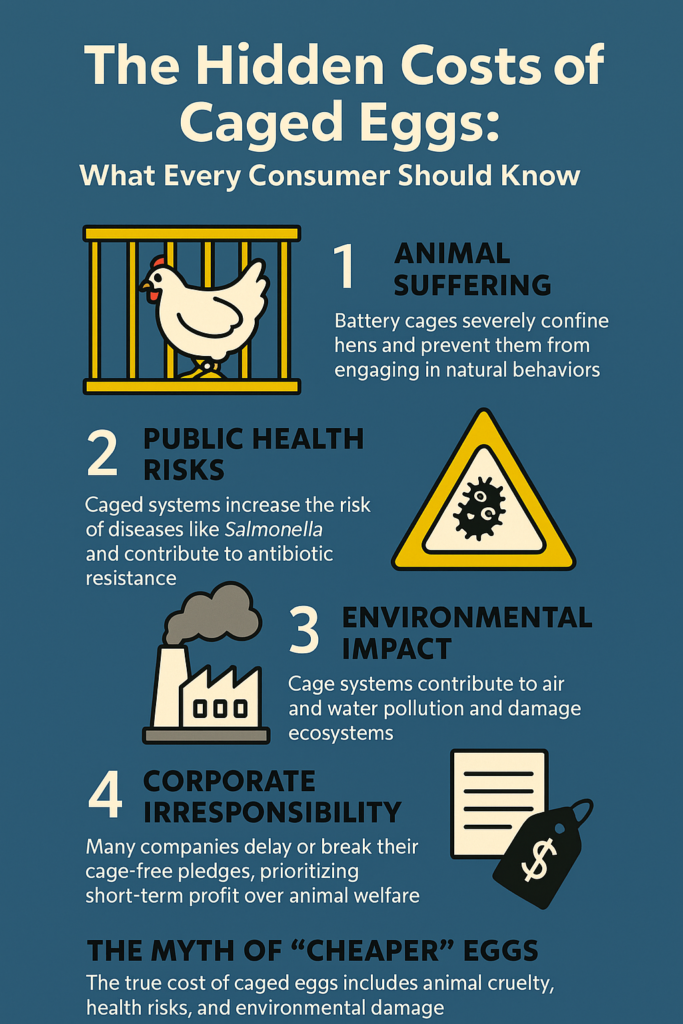
At first glance, caged eggs often seem like the “cheaper” choice. But behind the lower price tag lies a system that comes with steep, hidden costs—to animals, to public health, and to society as a whole.
In this post, we explore what’s really behind that carton of caged eggs—and why the true cost is far higher than what you pay at checkout.
🐔 1. Animal Suffering: Out of Sight, Out of Mind
Battery cages confine laying hens to a space no larger than an A4 sheet of paper. In these conditions, hens:
- Cannot walk, flap their wings, or stretch
- Suffer from muscle and bone deterioration
- Are denied natural behaviors like nesting and dust-bathing
This extreme confinement leads to intense physical and psychological distress. It’s one of the most severe forms of cruelty in industrial farming—yet it’s still standard in many parts of the world, especially in Asia.
⚠️ 2. Public Health Risks
Caged systems increase the risk of disease:
- Overcrowding and poor sanitation can lead to outbreaks like Salmonella
- Weak immunity from stress makes hens more susceptible to illness
- Antibiotics are sometimes overused to manage these conditions, contributing to antimicrobial resistance
What happens on the farm doesn’t stay on the farm—it can impact the health of consumers globally.
🌏 3. Environmental Impact
While often overlooked, cage systems contribute to environmental harm:
- Manure buildup can cause air and water pollution
- Intensive, high-density farms strain local ecosystems
- Poor waste management in large caged operations increases greenhouse gas emissions
Sustainable food systems cannot be built on the foundation of cruelty and contamination.
🧾 4. Corporate Irresponsibility and Broken Promises
Many multinational food companies have made public commitments to go cage-free—but quietly delay or backtrack when the spotlight fades. This behavior:
- Undermines public trust
- Signals a lack of accountability
- Keeps cruel systems in place longer than necessary
By continuing to source caged eggs, companies delay the shift toward more humane, responsible food supply chains.
💸 5. The Myth of “Cheaper” Eggs
Yes, caged eggs cost less at the register—but consumers rarely see the full picture. When factoring in:
- Animal cruelty
- Public health costs
- Environmental cleanup
- Loss of trust in brands
…it becomes clear that caged eggs are far more costly in the long run.
What You Can Do
- Choose cage-free eggs whenever available
- Ask questions at restaurants, hotels, and retailers
- Support transparency—encourage companies to publish regional progress on their commitments
- Get involved with organizations holding companies accountable
Final Thoughts
Every purchase is a vote. By rejecting the hidden costs of caged eggs and choosing higher-welfare options, we can protect animals, safeguard public health, and push the food industry toward real change.
It’s time to stop paying for cruelty with our wallets—and start demanding better from our food systems.